Exosomes for Male Pattern Hair Loss: What a New Clinical Trial Found
Medically reviewed by Robin Baradarian, MD, board certified physician, and Alfred Shirzadnia, DDS, cosmetic and implant dentist.
Hair loss is rarely “just cosmetic.” For many men, a receding hairline or thinning crown chips away at confidence long before it becomes obvious to anyone else. That is why the search for treatments that work, without the drawbacks of long-term medication, has moved toward regenerative science. A pilot randomized controlled trial published in the peer-reviewed journal Life in March 2025 offers one of the first controlled human looks at exosomes for hair loss in men.[1] Here is what the researchers did, what they found, and how to read the results.
Why Male Pattern Hair Loss Is Hard to Treat
Androgenetic alopecia (AGA), better known as male pattern baldness, is the most common type of hair loss. Over time, the growth (anagen) phase of the hair cycle gets shorter and the resting (telogen) phase gets longer. Follicles shrink, or “miniaturize,” and produce finer, weaker hairs until some stop producing visible hair at all.[1–3]
A key player in this process is the dermal papilla, a cluster of specialized cells at the base of each follicle that signals the surrounding cells to grow, divide and form the hair shaft. When that communication breaks down, the follicle shrinks.[2,3]
Standard treatments such as minoxidil and finasteride can slow hair loss and support regrowth. However, they need to be used long term to maintain results, their effectiveness varies, and some people experience side effects like scalp irritation, dizziness or reduced libido. These drawbacks lead many patients to stop treatment.[1,4]
What Are Exosomes and Why Are They Being Studied for Hair?
Exosomes are tiny vesicles, roughly 50 to 200 nanometers across, that cells release to communicate with one another. They carry proteins, growth factors, lipids and genetic messengers such as microRNA, delivering instructions that influence how neighboring cells grow, move and repair.[1,5]
Because they deliver these signals without introducing living cells, exosomes are considered a “cell-free” regenerative approach. Compared with stem cell therapies, researchers point to a lower risk of immune reactions and tumor formation, along with greater stability.[5] Laboratory and animal studies have shown that exosomes can encourage follicle cell growth, extend the anagen phase and help prevent follicle miniaturization.[6–8] Until recently, however, controlled human trials have been scarce.
The Botanical Partners: Ecklonia cava and Thuja orientalis
The formulation tested in the trial paired exosomes with two plant extracts that have each been studied for hair growth:
- Ecklonia cava, an edible marine brown alga rich in polyphenols called phlorotannins. In earlier research, its compounds reduced oxidative stress in dermal papilla cells, counteracted androgen-related signals linked to hair loss and supported follicle growth. In animal models, a topical extract also inhibited 5α-reductase, the enzyme that converts testosterone into DHT, a main driver of AGA.[9,10]
- Thuja orientalis (oriental arborvitae), a medicinal plant shown to activate the β-catenin and Sonic hedgehog signaling pathways, which drive follicle cell growth. In mice, a topical extract pushed resting follicles into the growth phase and increased follicle size and number.[11]
The researchers wanted to know whether combining exosomes as a delivery system with these botanicals would produce measurable regrowth in people. The combined formulation is referred to in the study as ECPE.
How the Study Was Designed
The trial was carried out by researchers at UCSI University in Kuala Lumpur, Malaysia, and the University of British Columbia, Canada, and was approved by the UCSI Institutional Ethics Committee.[1] Key design points:
- Randomized, double-blind and placebo-controlled. Neither the participants nor the clinicians giving treatments or assessing outcomes knew who received what.
- Participants: men aged 20 to 50 with Norwood grade 2–3 hair loss, meaning early to moderate recession and thinning. People with thyroid conditions, bleeding disorders, diabetes, current hair treatments, steroid or immunosuppressant use, or who smoked were excluded.
- Groups: 24 men were randomized. One group received a saline placebo (0.9% sodium chloride). The other received the exosome formulation containing 10 billion exosomes plus E. cava and T. orientalis leaf extracts. After dropouts, 10 men per group were analyzed.
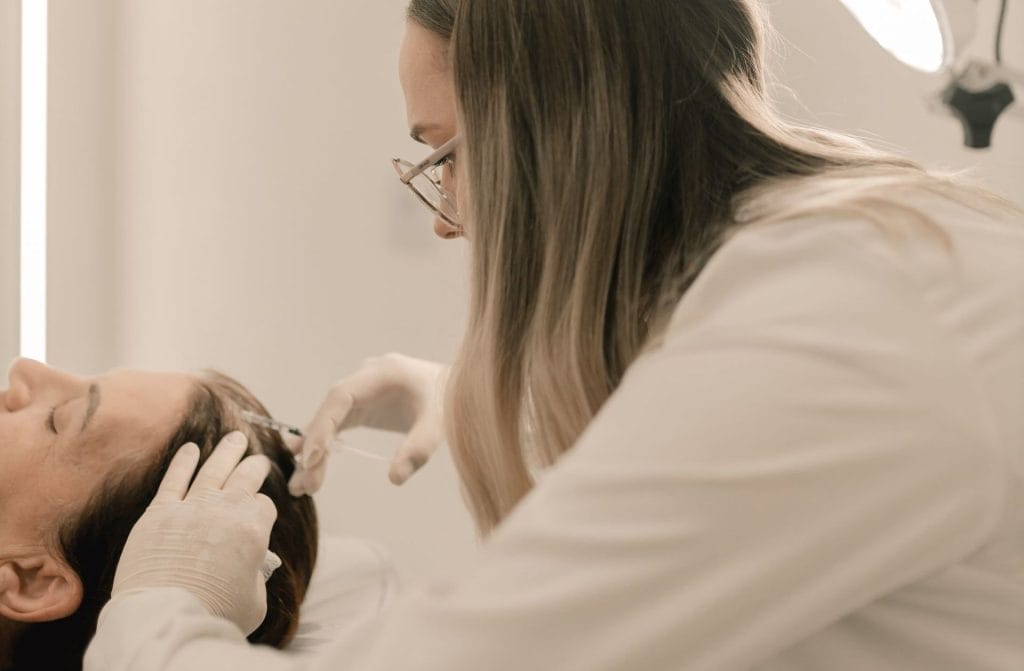
- Treatment: four sessions spaced 15 days apart, given by a certified aesthetic physician. After local anesthesia, about 5 mL was injected into the scalp in small amounts roughly 1 cm apart across thinning areas.
- Measurement: standardized photographs and high-resolution trichoscope images at baseline, week 12 and week 16. A blinded assessor counted hairs within a fixed 0.5 cm² area. Participants also rated their satisfaction on a validated five-point questionnaire.
What the Researchers Found
At the start, hair counts were similar between the two groups. Most participants had noticed hair loss for more than a year, and 80% first saw it as thinning on the scalp. After 16 weeks, the results diverged clearly.[1]
| Outcome at week 16 | Exosome formulation (ECPE) | Placebo |
|---|---|---|
| Change in hair count vs. baseline | Significant increase (p = 0.002) | No significant change (p = 0.163) |
| Median hair gain in measured area | 9.5 hairs | 1.5 hairs |
| Self-rated satisfaction (out of 5) | 4.20 | 2.90 |
| Side effects | Mild, temporary scalp irritation in 2 participants | None reported |
More Hair, With a Large Effect Size
The difference between the groups was statistically significant (p = 0.006), and the effect size was large (Cliff’s delta = 0.73). In plain terms, a man in the exosome group was much more likely to gain more hair than a man in the placebo group. Trichoscopic images of one participant showed the count in the measured area rising from about 58 strands at baseline to about 92 at week 16.[1]
The researchers also checked whether other factors could explain the results, including baseline hair count, Norwood grade and family history. None did. The treatment itself remained the significant factor.[1]
Patients Noticed the Difference
Satisfaction scores were significantly higher in the exosome group (4.20 vs. 2.90, p = 0.013). This matters because hair loss affects how people feel, not only what a hair count shows. Earlier research has linked effective hair loss treatment with improved self-confidence and quality of life.[12]
A Reassuring Safety Profile
No serious adverse effects were reported. Two participants in the exosome group had mild scalp irritation that cleared on its own without treatment.[1]
How Exosomes May Support Regrowth
The study measured outcomes rather than mechanisms, but the authors suggest the formulation may help “recalibrate” the hair cycle, moving dormant follicles back into active growth. Exosomes can deliver growth factors and signaling molecules that are lower in balding scalp, which may restore some of the communication that keeps follicles healthy.[1]
This fits with a growing body of preclinical work. Exosomes from dermal papilla cells have sped up the shift into the growth phase and delayed regression in animal models.[7,13] Exosomes from adipose-derived stem cells increased follicle regeneration and growth factors such as VEGF and PDGF in mice.[14] In people, injections of growth factors secreted by adipose-derived stem cells have been associated with hair regrowth in larger case series.[15]
At Exo Clinic Spa, exosome-enhanced options for thinning hair, such as PRF + Hairosome™ Hair Renewal, are part of our PRF and exosome-enhanced regenerative therapies. A consultation is the best way to find out whether they suit your type and stage of hair loss.
Reading the Results With Perspective
This is an encouraging study, and it is also a pilot. The authors themselves highlight its limits:[1]
- Small sample: 20 men completed the study, all from one country.
- Short follow-up: 16 weeks shows early response but not how long results last.
- Specific population: only men with early to moderate (Norwood 2–3) hair loss were included, so results may not apply to women or to more advanced loss.
- Open questions: the ideal dose, formulation and treatment frequency still need to be worked out.
Larger, longer trials are needed to confirm these findings. Still, a randomized, double-blind, placebo-controlled design with a large effect size and minimal side effects is a meaningful step forward for exosome-based hair restoration.
Key Takeaways
- An exosome formulation combined with Ecklonia cava and Thuja orientalis extracts significantly increased hair counts in men with early to moderate pattern hair loss over 16 weeks.
- The placebo group showed no significant change, and the difference between groups had a large effect size.
- Participants receiving the formulation reported significantly higher satisfaction.
- Side effects were limited to mild, short-lived scalp irritation in two people.
- As a small pilot study, the results are promising but need confirmation in larger, longer trials.
This article summarizes published research for educational purposes and is not medical advice. Individual results vary.
About the Medical Reviewers
Robin Baradarian, MD, board certified physician.
Alfred Shirzadnia, DDS, graduated from NYU College of Dentistry and completed an oral and maxillofacial surgery fellowship at Wyckoff Heights Medical Center, where he also served as chief surgical resident. His work focuses on cosmetic dentistry, dental implants and full mouth rehabilitation, and he is a member of the American Academy of Cosmetic Dentistry and the American Academy of Facial Esthetics.
References
- Amini F, Teh JJ, Tan CK, Tan ESS, Ng ESC. A Pilot Randomized Controlled Trial (RCT) Evaluating the Efficacy of an Exosome-Containing Plant Extract Formulation for Treating Male Alopecia. Life. 2025;15(3):500. https://doi.org/10.3390/life15030500
- Mao MQ, Jing J, Miao YJ, Lv ZF. Epithelial-Mesenchymal Interaction in Hair Regeneration and Skin Wound Healing. Front Med. 2022;9:863786.
- Ji S, Zhu Z, Sun X, Fu X. Functional Hair Follicle Regeneration: An Updated Review. Signal Transduct Target Ther. 2021;6:66.
- Nestor MS, Ablon G, Gade A, Han H, Fischer DL. Treatment Options for Androgenetic Alopecia: Efficacy, Side Effects, Compliance, Financial Considerations, and Ethics. J Cosmet Dermatol. 2021;20:3759–3781.
- Moghadasi S, Elveny M, Rahman HS, et al. A Paradigm Shift in Cell-Free Approach: The Emerging Role of MSCs-Derived Exosomes in Regenerative Medicine. J Transl Med. 2021;19:302.
- Ajit A, Nair MD, Venugopal B. Exploring the Potential of Mesenchymal Stem Cell–Derived Exosomes for the Treatment of Alopecia. Regen Eng Transl Med. 2021;7:119–128.
- Zhou L, Wang H, Jing J, Yu L, Wu X, Lu Z. Regulation of Hair Follicle Development by Exosomes Derived from Dermal Papilla Cells. Biochem Biophys Res Commun. 2018;500:325–332.
- Gupta AK, Wang T, Rapaport JA. Systematic Review of Exosome Treatment in Hair Restoration: Preliminary Evidence, Safety, and Future Directions. J Cosmet Dermatol. 2023;22:2424–2433.
- Kang JI, Kim SC, Kim MK, et al. Effect of Dieckol, a Component of Ecklonia Cava, on the Promotion of Hair Growth. Int J Mol Sci. 2012;13:6407–6423.
- Shin H, Cho AR, Kim DY, et al. Enhancement of Human Hair Growth Using Ecklonia Cava Polyphenols. Ann Dermatol. 2016;28:15–21.
- Zhang N, Park DK, Park HJ. Hair Growth-Promoting Activity of Hot Water Extract of Thuja Orientalis. BMC Complement Altern Med. 2013;13:9.
- Meyers A, Jin A, Kwiecien GJ, et al. Platelet-Rich Plasma for Treatment of Hair Loss Improves Patient-Reported Quality of Life. Aesth Plast Surg. 2023;47:1528–1534.
- Kwack MH, Seo CH, Gangadaran P, et al. Exosomes Derived from Human Dermal Papilla Cells Promote Hair Growth in Cultured Human Hair Follicles and Augment the Hair-Inductive Capacity of Cultured Dermal Papilla Spheres. Exp Dermatol. 2019;28:854–857.
- Wu J, Yang Q, Wu S, et al. Adipose-Derived Stem Cell Exosomes Promoted Hair Regeneration. Tissue Eng Regen Med. 2021;18:685–691.
- Fukuoka H, Narita K, Suga H. Hair Regeneration Therapy: Application of Adipose-Derived Stem Cells. Curr Stem Cell Res Ther. 2017;12:531–534.